

Benefits of Circus Classes for Kids in Rhode Island: Physical, Emotional & Academic Growth
We all know that children need movement and lots of it!
We also know that time and resources are often limited and with so many different movement programs in Rhode Island, it’s hard to know which activity to commit to! Which program is the right fit for your child, which will they actually enjoy and benefit from?
For some kids, traditional competitive after-school sports can be a good solution.
Other kids need something different to really thrive. Something that builds…
Strength without adding stress.
Confidence without comparison.
Lasting friendships without social hierarchy.
_______________________________
My name is Ana Coffey. I’m an aerial circus coach at Rhode Island Circus Space. I began training in 2008 and have been teaching youth circus classes since 2013. Over the years, I’ve watched kids grow stronger, more resilient, and more confident through circus classes. And I’ve seen these benefits positively radiate out into their greater life experience, serving them all the way into adulthood.
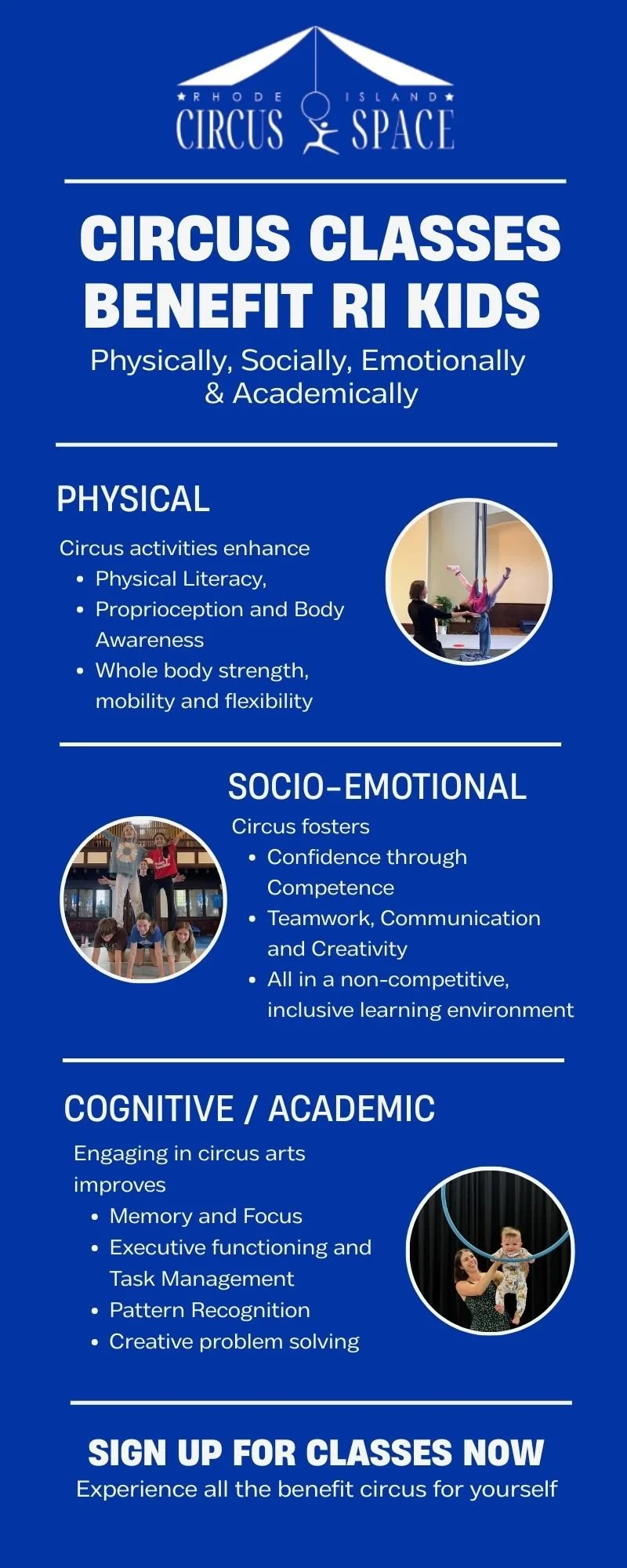
Here’s some practical information for parents and guardians about how circus training supports kids physically, emotionally, and cognitively — and why the impact lasts.
Physical Benefits of Circus Classes for Kids
Physical Literacy: The Foundation for Lifelong Movement
Physical literacy is the combination of movement competence, confidence, and motivation that supports lifelong activity.
Circus develops all three.
Unlike single-sport programs or highly specialized movement styles like dance or gymnastics, the wider circus tent hold many different disciplines and includes a huge amount of skill sets! We can break these down into five main categories:
Aerial arts (fabric, lyra)
Acrobatics and tumbling
Object manipulation (juggling)
Balancing disciplines (tightwire, rolling globe)
Physical theater and clowning
Across these disciplines, kids get the chance to practice and become proficient in foundational movement patterns such as:
Running and jumping
Climbing and hanging
Balancing
Twisting and inverting
Throwing and catching
Complex movement sequencing
Instead of boxing children into an early movement specialization, circus classes build adaptable, well-rounded movers and provide a broad and solid foundation for success in whatever movement styles they decide to pursue later in life.
As noted in Circus Activities as a Health Intervention for Children, Youth, and Adolescents: A Scoping Review, the multi-disciplinary nature of circus allows many different activities to work toward shared developmental goals.
2. Proprioception & Body Awareness
Proprioception is the body’s ability to sense its position and movement in space without relying on vision. This improves balance, coordination, and spatial awareness.
Circus strengthens proprioception because kids practice moving 360 degrees:
Forward and backward
Side to side
Upside down
Spinning and twisting
All while potentially suspended in the air or while falling in controlled ways
Circus also emphasizes Body Awareness and the mind–muscle connection. Students learn how to feel and recognize the details of what their body is doing internally and externally — and how to verbally describe it to others. That awareness and ability to communicate supports injury prevention, emotional regulation, and lifelong physical confidence.
3. Whole-Body Strength, Mobility & Flexibility
Circus is a full-body workout disguised as fun!
Especially in aerial and acrobatics classes, students develop:
Core strength and stability
Shoulder, back, and grip strength
Lower body power
Stabilizer muscle control
Joint mobility and flexibility
Classes typically include warm-ups, conditioning, skill-building, and flexibility training. All embedded within engaging, creative practice and because circus is genuinely exciting, kids tend to stick with it. The longer students are able to commit to a movement practice to greater the short and long-term benefit.
Social & Emotional Benefits of Circus
1. Confidence Through Competence
Recreational circus classes build confidence differently than traditional sports.
There are no tryouts. No ranking systems. No harsh consequences for failure.
One of the most powerful aspects of circus training is how it builds confidence, not through competition, but through acquired competence. Circus classes are structured with Progressive Skill-Building meaning that each movement and new skill can be simplified or made more challenging, allowing students to:
Progress at their own pace
Experience early and frequent success
Tackle increasingly complex challenges
Research summarized through PubMed Central highlights how this scaffolded model creates incremental challenge, supports confidence and persistence and strengthens:
Autonomy
Decision-making
Healthy risk assessment
Intrinsic motivation
Essentially, children have the opportunity to complete confidence building cycles of … struggle, fail safely, try again, and eventually succeed.
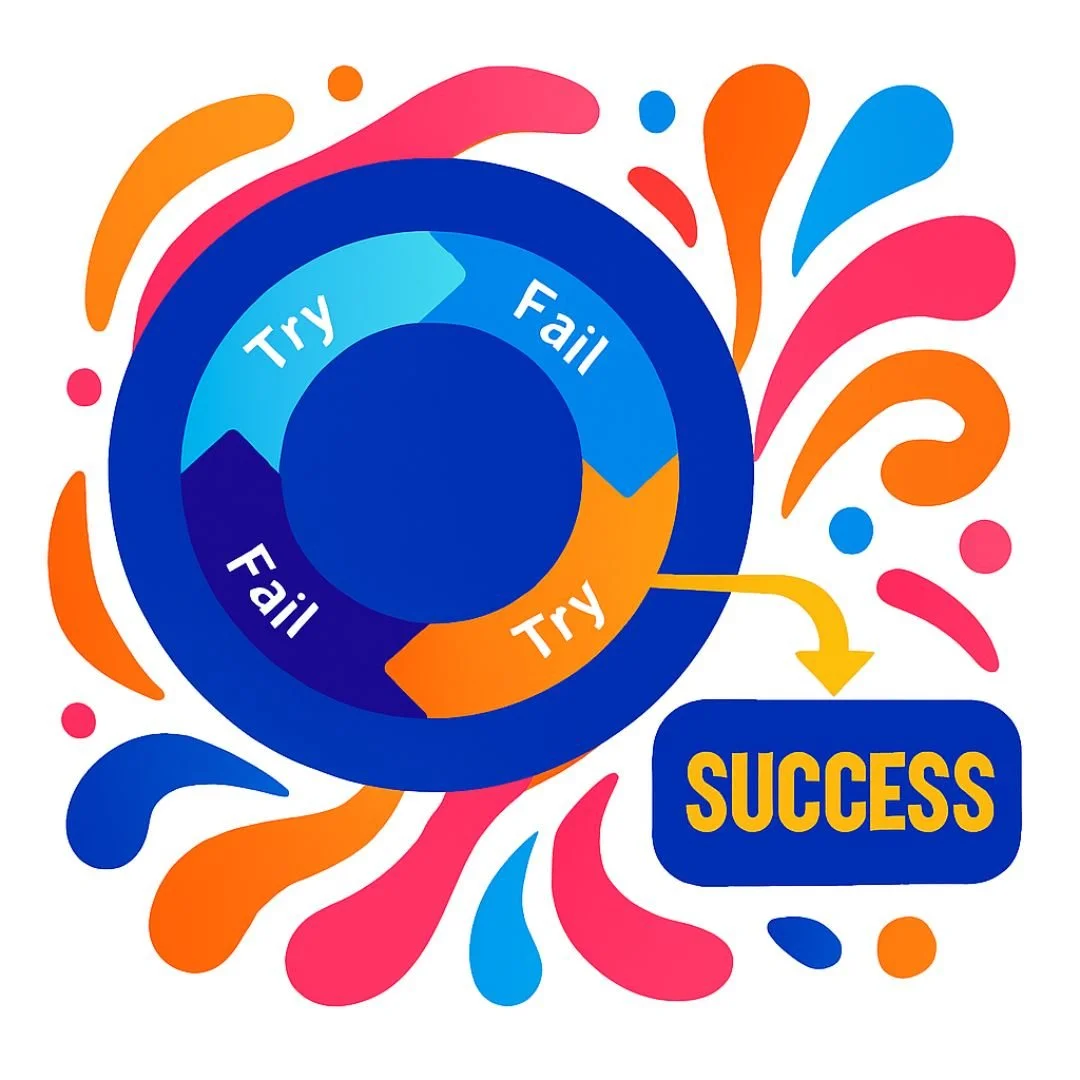
This repeated cycle develops authentic confidence based on the knowledge and belief in their own hard-earned competence and experience. This is the type of confidence that lasts and cannot be taken away! It also creates a learning habit that translates to greater confidence and success in every other area of life.
2. A Non-Competitive, Inclusive Environment
In order to participate in the confidence building cycle, kids need to feel safe enough to try and fail in the first place.
Circus helps with this by being:
Non-competitive
Gender-neutral
Body-positive
Adaptable across differing abilities
Because there are so many disciplines, every child can find something they feel immediately successful in, while still being challenged. This balance keeps kids engaged and allows them to receive the benefits of circus over the long term.
In this environment, kids get to:
Relax and decompress
Engage in imaginative play
Explore creative problem-solving
Be fully themselves
There are many kids who feel like they don’t quite fit in when it comes to school or traditional sports. Circus classes may just be the first place where these kids feel like they are seen, accepted and appreciated. That sense of belonging can do wonders for confidence, emotional resilience and overall mental-health.
3. Teamwork, Communication & Creativity
Circus is exploratory, creative, expressive and collaborative by nature.
Students regularly:
Work in pairs and small groups
Spot and support each other physically and emotionally
Create sequences together
Practice clear, empathetic communication
Encourage one another through vulnerable situations like performances
Studies such as The Art of the Circus: Cartwheeling Kids to Better Mental Health report increased feelings of confidence, freedom, and reduced stress among youth participants.
The strong friendships formed in circus create social resilience that can carry over into other areas of life. Having a friend group that is separate from school and home can help children learn more about themselves and allow them to take on social roles they wouldn’t have the opportunity to otherwise. For example, a student who is passive at school may take on a leadership role in their circus group. Or a student who may be very serious and academically driven might find a place to relax and be silly, playful and creative.
Cognitive & Academic Benefits of Circus
Movement and brain function are deeply connected. A quick google search will provide you with more research studies on this topic than you could ever read. Even though most of these studies focus on general movement qualities, circus classes have some additional advantages.
Circus classes create a low-stress and emotionally engaging environment where kids are constantly solving physical problems logically and creatively. This is the ideal situation for learning and brain development.
During classes, kids also practice:
Sustained focus
Executive functioning
Task prioritization
Pattern recognition
Memorization of complex sequences
Research summarized by Active Living Research links regular physical activity with improved attention, memory, and academic performance.
Physical activity also supports better sleep, emotional regulation, and stress management — all foundational to learning.
Why Circus Classes in Rhode Island Offer Something Different
Circus training isn’t just about learning tricks.
It builds physical literacy.
It strengthens resilience.
It supports academic growth.
It creates belonging.
For kids and teens in Rhode Island, circus can be more than an extracurricular activity. It can be a place where intense growth happens during creative play without feeling like pressure.
It’s where kids get to be silly with friends while overcoming serious challenges.
It’s where they learn that everyone is good at something and everyone is still learning.
And for many kids who have never quite felt like they fit in elsewhere, circus becomes their home away from home, a place where they finally belong.